ASTM A53 Grade A vs. Grade B: What is the Difference?
A common comparison in the construction world and industrial projects is between ASTM A53 Grade A and Grade B. It is a choice that engineers and contractors are expected to make when they wish to utilize pipes made of carbon steel. The two grades are stipulated in the ASTM A53 standard, though they have various performance and uses.
This manual describes such distinctions in an easy manner. It puts attention on strength, usage, and compliance. This is to enable you to make the right decision on the grade.
General Description of ASTM A53 Steel Pipes
ASTM A53 is a carbon steel pipe. These are structural, mechanical, and pressure pipes. These come as seamless and welded. The criterion contains two primary grades. These are Grade A and Grade B. Although they resemble, their mechanical characteristics are different. The ASTM A53 Grade A vs Grade B knowledge makes the right selection of materials.
What Is ASTM A53 Grade A?
Grade A is used in general structural applications. It has fundamental strength and excellent welding. The grade is commonly employed in cases where high pressure is not an issue. It works well in structures, supports, and low-stress environments. It is less difficult to fabricate because it requires less strength. Grade A is light-duty as compared to ASTM A53 Grade A and Grade B.
What Is ASTM A53 Grade B?
The stronger form of the same standard is Grade B. It is made to sustain greater stress and pressure. This grade is very common in pipelines, mechanical systems, and industrial plants. It works well when there is internal pressure and loading. In comparing ASTM A53 Grade A and Grade B, Grade B should be used in a challenging application.
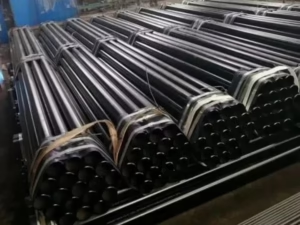
Significant Mechanical Strength Dissimilarities
The significant technical difference between the two grades is strength. Grade B has higher tensile and yield strength.
There is a distinct comparison as given in the table below:
| Property | Grade A | Grade B |
|---|---|---|
| Minimum Yield Strength | 30,000 psi | 35,000 psi |
| Minimum Tensile Strength | 48,000 psi | 60,000 psi |
This strength difference is the reason why Grade B is used in the pressure-related work.
Performance-Based Applications
The grades are more appropriate in different environments. Selection is based on the level of stress and the need for safety.
Grade A is commonly used for:
- Structural supports
- Building frames
- Low-pressure systems
Grade B is commonly used for:
- Fluid transport lines
- Pressure pipelines
- Mechanical systems in industries
This is the division of application that is at the center of the decision between ASTM A53 Grade A and Grade B.
Capability of Dealing with Pressure
Many systems are important to pressure resistance. Grade B is more pressure-resistant.
This is applicable to water, air, steam, and gas lines. Grade A cannot be used in high-pressure flow.
The knowledge of this element mitigates the chances of system failure.
Weldability and Fabrication
The two grades are well weldable. Grade A is, however, a bit easier to create.
Reduced strength implies reduced heat input in the welding. It is useful for easy construction.
In the comparison of the ASTM A53 Grade A and Grade B, it was found that Grade A is easily fabricated.
Compliance/Inspection Issues
The two grades should comply with the ASTM testing. These are chemical examination and mechanical tests.
Grade B is usually regarded with more scrutiny as it is used in pressure systems. Approval is important with respect to documentation.
Checks on compliance assist in the safety and performance in the long term.
Price Disparities between the Two Grades
The other factor of determination is cost. Grade B tends to be more expensive because of an increase in strength.
Grade A is cheaper when non-pressure is utilized. When the right grade is chosen, wasteful spending is avoided.
As there is a match in material to the application needs, there is cost efficiency.
Best Misconceptions in the Industry
It is assumed that these two grades can be used interchangeably. This is incorrect.
Grade A is dangerous when used in pressure systems. There is no need to use Grade B in complex constructions.
The difference between ASTM A53 Grade A and Grade B has to be comprehended at the design level.
Dimensional Availability
The similarity of the two grades is in their sizes. They are various in the diameters and wall thicknesses.
The Grade A vs Grade B of ASTM A53 is not normally influenced by availability. The most important are the performance requirements.
Project Specifications ASTM A53
The grade required is usually spelled out in project specifications. Engineers choose on the basis of calculations of loads.
Failure to pay attention to specifications results in the rejection of the product during the inspection process. Grade choice preferred grade choice facilitates effortless project implementation.
Selection of Steel Pipe for Long-term Use
Life cycle systems need durability. Grade B has more resistance to recurrent strain.
Grade A is very successful in stationary constructions. The appropriate grade is the choice to enhance the service life.
This justifies the significance of the evaluation of ASTM A53 Grade A vs Grade B.
Global Use and Acceptance
The two grades are both popular in the international world. They are applied in plants, infrastructure, and buildings. They are most popular because they are reliable and standardized. ASTM A53 Grade A vs Grade B is still the world point of reference.
Technical Summary
The comparison between ASTM A53 Grade A vs Grade B steel pipe reduces to the issues of strength and use. Grade A suits structural use. Grade B is a pressure system suit. The knowledge of such differences helps to avoid expensive mistakes. It enhances safety and compliance, also.
Conclusion
The grade of A53 of ASTM A53 is not about appearance but performance. Grade B is stronger and more pressure-resistant. Grade A is more cost-efficient and easier. The right grade will guarantee safety, efficiency, and reliability in the long run. Good engineering decisions are made through proper understanding at Arif Alkhayr.