
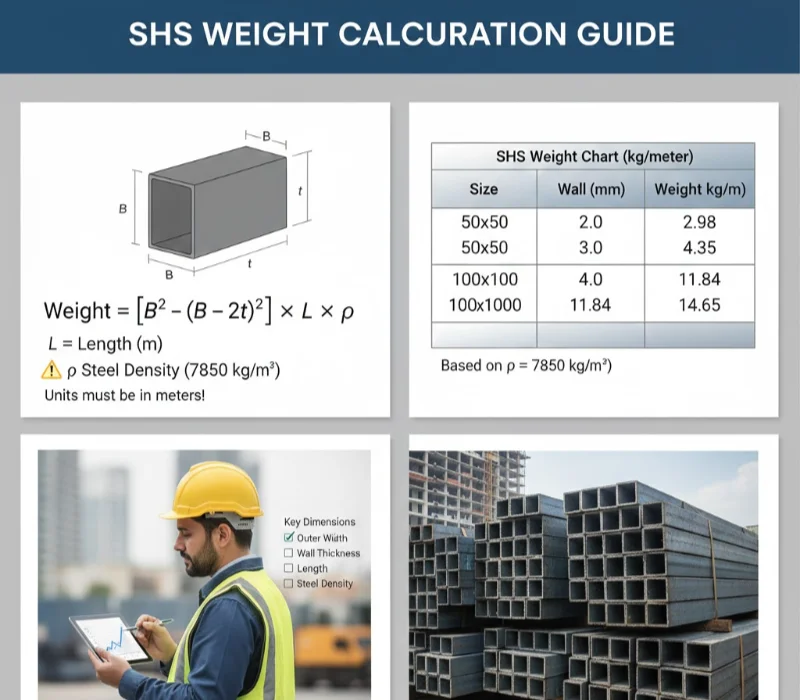
In the steel design and structural planning, the SHS weight plays a significant part. Section weight can be known by the engineers and fabricators; therefore, they can confidently plan loads, costs, and safety. Long hollows consisting of squares are very common in buildings and frames, and also in industrial structures. They are powerful and effective due to their shape being the same. This guide illustrates the ways of computing weight using the formulas and charts to determine weight. The definition is clear and applicable in daily life.
Square Hollow Sections Defined
Square hollow sections, also known as SHS, are hollow steel profiles that have a square shape. They are famous due to the fact that they are strong and less materialistic. The hollow core minimizes the mass without minimizing performance. They are applied to columns, beams, trusses, and frames. They are symmetrical and so can be fabricated easily. They are also more favorable to engineers because of their clean looks and predictable performance in the field of load.
The Importance of Weight Calculation
It is necessary to know the precise weight of steel sections. Weight influences the structural loading of the structure and the foundation design. It also affects the costs of transporting and handling. Fabricators are based on reliable figures in order to estimate the material requirements. Weight data is used in budgeting and scheduling by the contractors. Failure to make the right calculations may result in fluctuations in safety or an increase. This is the reason why it is so crucial to know the right approach.
Key Dimensions Used in Weight Calculation
There are a few dimensions required to compute the mass of a square hollow section. These consist of the external width of the section. The wall thickness is also necessary. The length of the section is to be known. Steel density is commonly considered to be a standard. The majority of the calculations consider the steel density to be $7850\text{ kg/m}^3$. The consistency of projects is achieved by using these values.
| Dimension | Symbol | Unit of Measurement |
| External Width | B | Millimeters (mm) or Meters (m) |
| Wall Thickness | t | Millimeters (mm) or Meters (m) |
| Section Length | L | Meters (m) |
| Steel Density | $\rho$ | $7850\text{ kg/m}^3$ |
Basic Formula Explained
The equation of hollow steel sections is simple. The area of the outer square is first found. Subtract the area of the inner hollow square, then. Multiply the rest of the area by the length. Lastly, multiply by the density of steel. This gives the total mass. This method is very common in the engineering field. It is also compatible with manufacturer information.
The formal mathematical expression is:
The Step-By-Step Method of Calculation
It becomes an easy process when it is decomposed:
Square the outer dimension, beginning with the outer dimension. This gives the outer area.
Next, allowance of the wall thickness twice on the outside.
Squaring this value would obtain the inner area.
Difference of area of the inner and outer.
The result multiplied by the length of the section gives the volume.
Multiplier density of steel. What is left is the total weight in kilograms.
Practical Example for Better Quality
Suppose we have a hollow section in the form of a square and of outer width 100 millimeters. The thickness of the wall is five millimeters. Length is 6 meters. Scale dimensions into meters. Calculate the formula step by step. You will get a precise result. This is one of the ways that engineers can use to eliminate confusion. It also enhances accuracy in drawings and schedules of materials. Using high-quality square tubes ensures that the physical dimensions match these calculations perfectly.
Using Charts for Quick Reference
Most of the professionals like pre-made charts. These tables contain the common sizes and their weight per meter. Tables are time-saving in terms of design and estimation. They particularly come in handy when it comes to repetitive work. Nonetheless, standards should be used to check charts. This makes sure that values are similar to local manufacturing tolerance.
Understanding Square Hollow Weight in Design
The square hollow weight also affects the performance of the structures when they are subjected to a load. The upper sections are made lighter, which decreases the dead load on foundations. The heavier parts offer stiffness to compression and bending. These are well-balanced by designers. The seismic and wind load calculations also depend on weight data. Correct statistics enhance the reliability and safety of structures.
How SHS Weight Calculation Improves Accuracy
SHS weight calculation helps avoid cases when the engineers base their calculations on assumptions. Confidence is gained through calculated values in the analysis. They are also used in the procurement and fabrication. In the case of precise values, the waste is minimized. Projects remain in budget and schedule. This is a critical way of calculating needed in professional practice. If your project requires customization, pipe threading and grooving services Madinah can provide the necessary adjustments while maintaining weight integrity.
Difference between Standard Sizes
Square hollows are made in varied sizes. The thickness of the wall may be a wide range. Exterior looks may resemble, but mass may vary drastically. Even the slight thickness variations give impact on the total mass. This is why it is necessary to consider every section separately. These variations are managed by the use of charts and formulas.
Common Mistakes to Avoid
Conversion of units: One of the errors that should not be overlooked. The confusion of millimeters and meters leads to errors.
Density Assumptions: Any two different pieces of steel may not be of the same density. Standard density should always be used unless it is indicated otherwise.
Wall Thickness: It is also dangerous to omit the accuracy of the wall thickness.
Double Checking: Making sure that values are checked again. Even minor mistakes may become major issues in the future.
Application in Construction and Fabrication
There are square hollow sections applied in residential, commercial, and industrial applications. They occur in frames, staircases, and supports. Fabricators cut and weld them in an easy way. Their systematic form enables them to be interconnected neatly. Computation of weight assists in the choice of cranes and hand equipment. It also provides on-site safe installation. For plumbing or fluid transport, you might also compare these to round pipes for weight efficiency.
Professional Help for Accurate Results
Formulas are useful, but professional support is added value. Arif Al Khayr is the best in offering SHS weight calculation services that give the correct results that can be trusted by engineers and contractors with total confidence. We have a team of experts in SHS weight calculation, which means accurate calculations and sound advice. Our professionals are familiar with codes, tolerances, and real-life issues. Outsourcing this kind of work saves time and minimizes risk.
Comparing Square Section Weight across Profiles
The square section weight is not the same as that of a rectangular or circular section. All the profiles possess distinctive characteristics. Balanced strength in every direction is provided by the square sections. The comparison method of weight assists the engineers in making the most appropriate choice. It also helps in the optimization of material use. The appropriate choice of a profile enhances efficiency.
Significance of Standards and Specifications
Address international or local standards constantly. Tolerances and grades of materials are defined using standards. They also offer checked weight slabs. The standard data compliance ensures compliance. It also does not result in quarrels during inspections. Standards serve as a reliable source for engineers the world over.
Final Thoughts
Knowledge of SHS weight is a must for any individual dealing with steel structures. Safety and efficiency are enhanced by making rightful calculations. They also assist in controlling the cost and waste. Precision is important whether it is formulas or the use of charts. It is a process that is easy and dependable with practice. It would always save time to do the right calculations.